
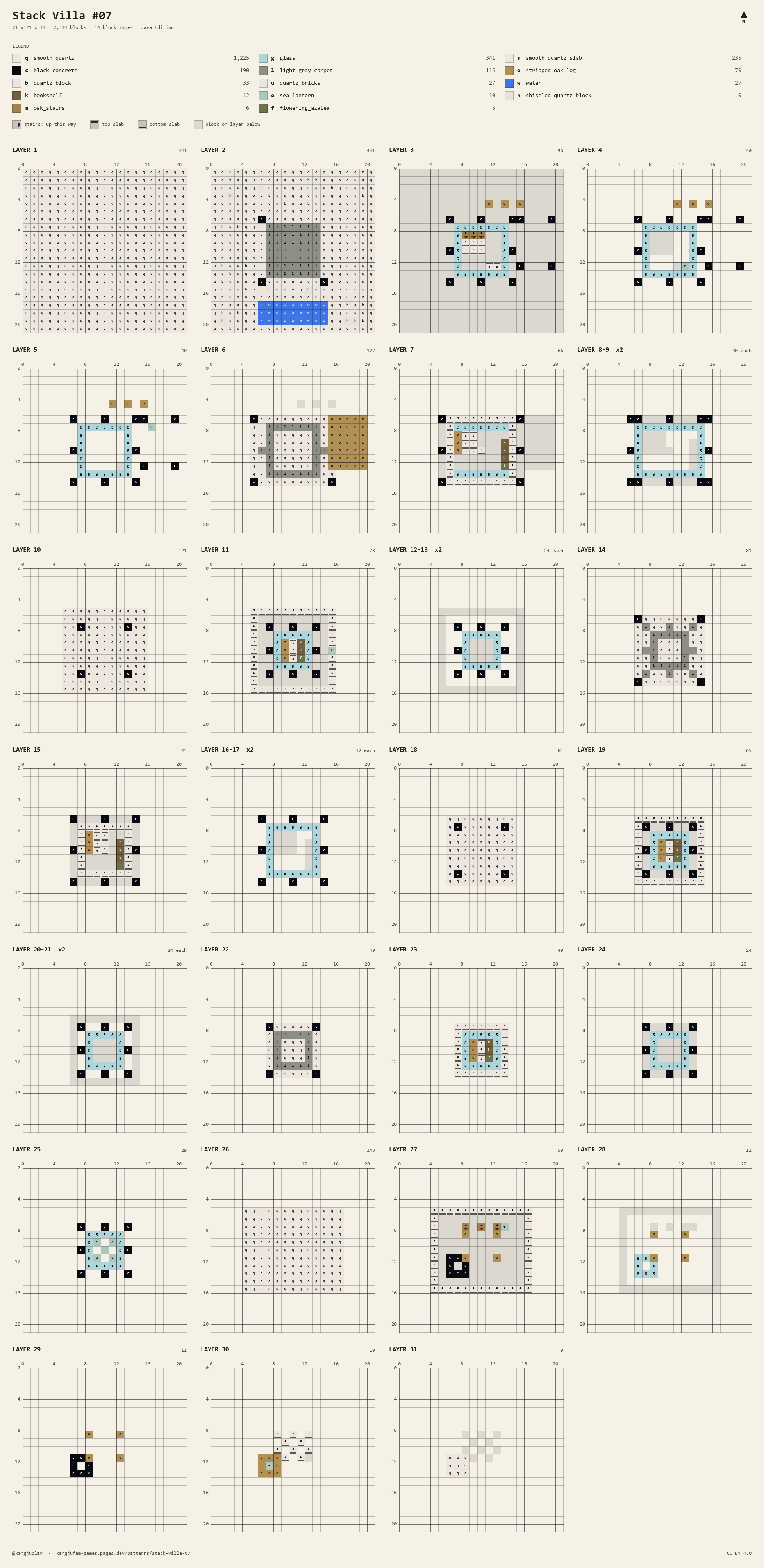
The building from episode 7 of the build timelapse, the series with four bots on site. Six narrow glass storeys are stacked on a wide deck, alternately jutting out — a stack villa. 31 layers, 2,314 blocks, in white smooth quartz with black concrete columns and stripped oak log bands.
The video shows 3,149 blocks; the pattern has fewer because the trees, flowers and hedges around the villa are left out. Only the building you would follow is kept.
The key idea — walls in three layers
A single flat wall is what makes a build look plain. This villa's walls read as three layers: on the outer face, black concrete columns every 4 blocks with open gaps between; one block inside, an unbroken ribbon of glass; inside that, carpet floors and furniture.
The open gaps put the glass one block back in shadow, and the columns and the log band between floors frame it like a window. The glass is pulled in rather than the columns pushed out so the building does not get any wider.
Layer by layer
LAYER 1–2 — deck and pool. A two-layer 21 × 21 deck. The top layer mixes in quartz blocks and quartz bricks so the big floor is not one flat colour, and a 9 × 3 pool (27 water) is set into the south side. Light grey carpet marks the interior.
LAYER 3–5 — ground floor. Black columns and glass, with wooden louvres on one end only, and an open carport of four posts and a roof beside it.
From LAYER 6 — a storey every 4 blocks. Each floor layer (6, 10, 14, 18, 22) gets a smooth quartz floor. Alternate storeys are wider so they jut out in turn, and each storey steps back so the roof below becomes a terrace with a one-slab railing.
LAYER 26–27 — roof. A 13 × 11 roof deck with a slab railing, oak stair benches and sea lantern lights.
LAYER 28–31 — stairwell and pergola. A 3 × 3 stairwell rises 4 blocks off to one side; a pergola of four log posts and a slab grid stands on the other. Neither is centred, so the outline changes depending on the viewing angle.
Gathering materials
1,225 smooth quartz and 235 slabs is 1,343 smooth quartz with a stonecutter. Smooth quartz is smelted quartz block, and each quartz block is 4 Nether quartz — about 5,400 Nether quartz. That is the real wall in survival; white concrete is the practical substitute.
341 glass is 341 sand; 190 black concrete is 24 batches of powder (8 each). Sea lanterns come from ocean monuments or 4 prismarine shards + 5 crystals. Flowering azalea comes from azalea trees above lush caves.