
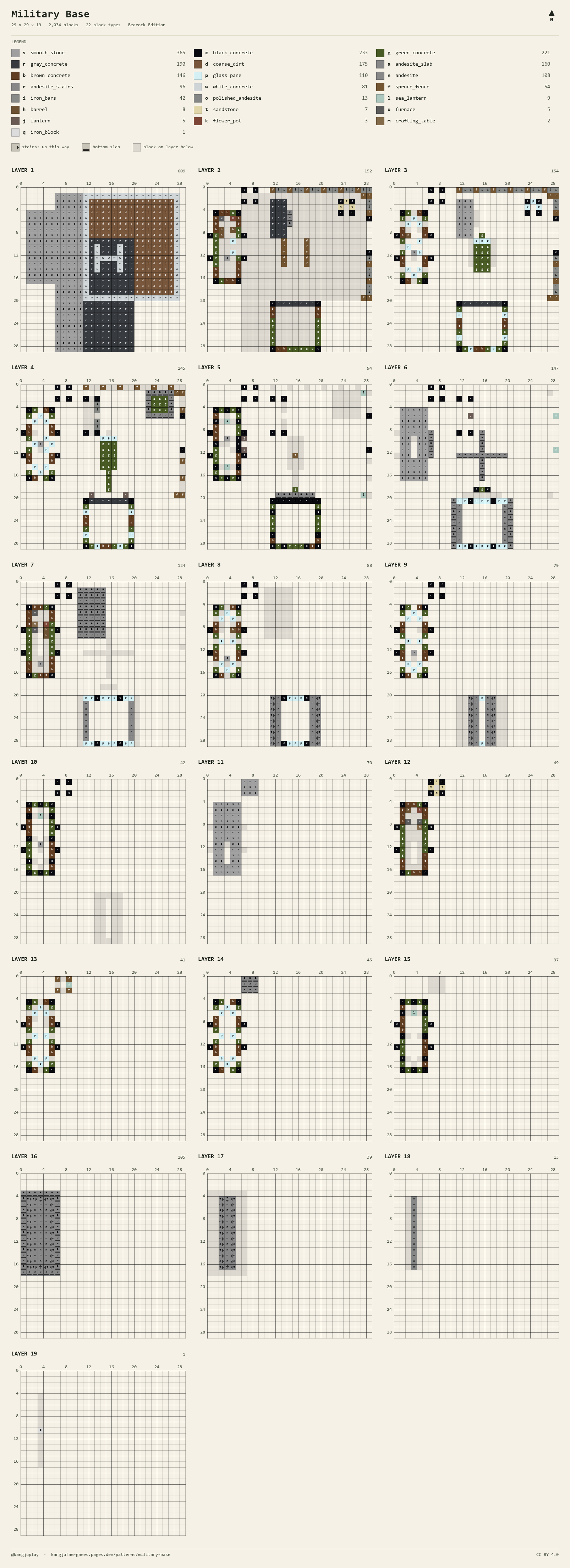
A military base laid out around a three-storey barracks with camouflage walls. Beside it is a coarse-dirt parade ground, with a helicopter sitting on a gray helipad in one corner. A roofed reviewing stand and a sentry box sit at the edges of the ground, a tall watchtower stands at the north end of the road, an arched hangar waits behind the helipad, and an iron-bar fence closes the north and east sides. 29 × 29 blocks, 19 layers, 2,034 blocks, 22 block types.
The main gate is in the right-hand (east) fence of the pattern, and the barracks door also faces east onto the parade ground. The barracks walls mix green, brown and black concrete into a camouflage pattern, and the barracks, stand and hangar roofs share the gray of the andesite family. In the short, the base grows through three sizes — small (319 blocks), medium (1,000) and large (2,034). This pattern is the largest.
Layer by layer — the ground, three barracks storeys, the facilities
LAYER 1 — the ground. 205 smooth stone for the 5 × 13 barracks floor and a road beside it, 5 wide and 28 long. East of the road is the 15 × 17 parade ground — 175 coarse dirt inside a white concrete border (68 blocks) — with an 8 × 10 helipad of 67 gray concrete in its south-west corner and an H of 13 white concrete. The 9 × 9 south of the ground is the hangar floor (81 gray concrete).
LAYER 2–5 — barracks ground floor. Black concrete at the corners and a camouflage mix of green, brown and black on the walls, with a black pilaster sticking out one block at two points on each long wall (grid lines 8 and 12 of the pattern). Windows are 1 wide and 2 high (LAYER 3–4) with the glass pane set one block in. The middle bay of the front has the door (LAYER 2–3) with a glass pane above it and a three-high glass window either side, and at LAYER 6 a canopy of five andesite slabs with two lanterns hanging beneath. Two sea lanterns light the ceiling.
LAYER 2–7 — reviewing stand and sentry box. The stand, at the north-west edge of the parade ground, is a two-high platform — a 3 × 7 of gray concrete topped with a 3 × 7 of smooth stone. On the parade-ground side it has three andesite slab steps and a four-piece iron bar railing, and black posts at its four corners (LAYER 4–6) carry a 5 × 9 roof of 45 andesite slabs on LAYER 7, with one lantern hanging under it. The sentry box is a 3 × 3 in the north-east corner of the ground: four black posts with a course of sandstone and a course of glass panes between them, open to the south for the door. Its LAYER 4 roof is a 3 × 3 of green concrete edged with 16 andesite slabs.
On the helipad — one helicopter (73 blocks). Set a green concrete body (3 wide × 5 long, LAYER 3–4) on ten fence legs, with a six-pane glass cockpit and a one-block nose at the front (north). Behind it go a four-block tail (LAYER 4), a tail fin and a tail rotor on LAYER 6; on top, a fence mast carries a nine-long cross-shaped main rotor of 17 andesite slabs.
LAYER 2–9 — the hangar. The north face, looking onto the helipad, has a big 7 × 3 gray concrete door, with a canopy of seven andesite slabs in front of it on LAYER 5 and a lantern at each end of the door. The side walls use the same three-colour camouflage as the barracks, with two windows each. LAYER 6–9 is a roof of 64 andesite and 36 andesite stairs curving in from both sides, and the front and back gables are glass pane walls (18 per face) with two black ribs.
LAYER 2–14 — the watchtower. At the north end of the road, raise black concrete posts at the four corners of a 3 × 3 up to LAYER 10. LAYER 11 is a 3 × 3 smooth stone floor, LAYER 12 a parapet of black corners and four sandstone, LAYER 13 four fence posts with a sea lantern in the middle of the east side, and LAYER 14 a 3 × 3 roof of andesite slabs — 67 blocks.
The fence. Along the north and east edges, spruce fence posts (three high) stand every three blocks with two rows of iron bars between them. The gate is the five-block gap in the middle of the east fence, with a sea lantern on each four-high black concrete gatepost, and the fence posts at the two ends of the east side carry a sea lantern each.
LAYER 6 and 11 — barracks upper floors. 61 smooth stone each, leaving four gaps for the stairs. LAYER 7–10 and LAYER 12–15 repeat the ground-floor pattern, except that the middle bay of the front has a single window instead of the door. Each upper floor has one ceiling sea lantern.
LAYER 16–19 — barracks roof. LAYER 16 is a 7 × 15 eave of 40 andesite slabs around 32 andesite stairs and 33 andesite; LAYER 17 steps in with 28 stairs and 11 andesite. LAYER 18 is a ridge of 13 polished andesite, and LAYER 19 puts a single iron block in the middle of it.
How much material?
Smooth stone, 365, is the biggest item — 205 for the ground and road, 122 for the barracks floors, then 21 for the stand, 9 for the watchtower and 8 stair steps. It is cobblestone smelted twice (cobblestone → stone → smooth stone), so 365 cobblestone means 730 smelts — about 92 coal at 8 items per coal.
Concrete, 871: 233 black, 221 green, 190 gray, 146 brown and 81 white. At 8 powder per batch (4 sand, 4 gravel, 1 dye) that is 112 batches — 448 sand and 448 gravel, with 30 black dye (ink sacs), 28 green (smelted cactus), 24 gray (black plus white), 19 brown (cocoa beans) and 11 white.
The andesite family is 108 andesite, 160 slabs, 96 stairs and 13 polished andesite. With a stonecutter (one block → one stair, two slabs or one polished andesite) you need 297 andesite in total. At a crafting table (6 → 4 stairs, 3 → 6 slabs, 4 → 4 polished) it is 349. Andesite is common in underground patches — just mine it.
Coarse dirt, 175 is 2 dirt and 2 gravel for 4, so 44 crafts — 88 dirt and 88 gravel. Grass does not spread onto coarse dirt, so the parade ground stays bare. Then 110 glass panes (42 glass), 54 spruce fences, 42 iron bars (18 ingots), 9 sea lanterns, 7 sandstone and 1 iron block. 8 barrels, 5 furnaces, 3 flower pots and 2 crafting tables are barracks furniture, and the 5 lanterns hang under the canopies and roofs.
Tips
Lay out the ground first. Place the white concrete border and the helipad H on LAYER 1 before filling in the coarse dirt and gray concrete, and the spots for the stand, sentry box, helicopter and hangar fall into place.
All three barracks storeys share one pattern (only the ground-floor middle bay has the door). Once the ground floor matches the pattern, copy it upwards floor by floor. The projecting black pilasters break at the floor layers (LAYER 6 and 11).
Leave the helicopter rotor for last. The LAYER 6 cross is centred right above the LAYER 5 fence mast and reaches four blocks in each direction.
The hangar roof has an open line along the top (LAYER 9, seven blocks) in the pattern, so from above you can see the floor. Nothing is missing — leave it, or cover it with andesite slabs if you prefer it closed.