
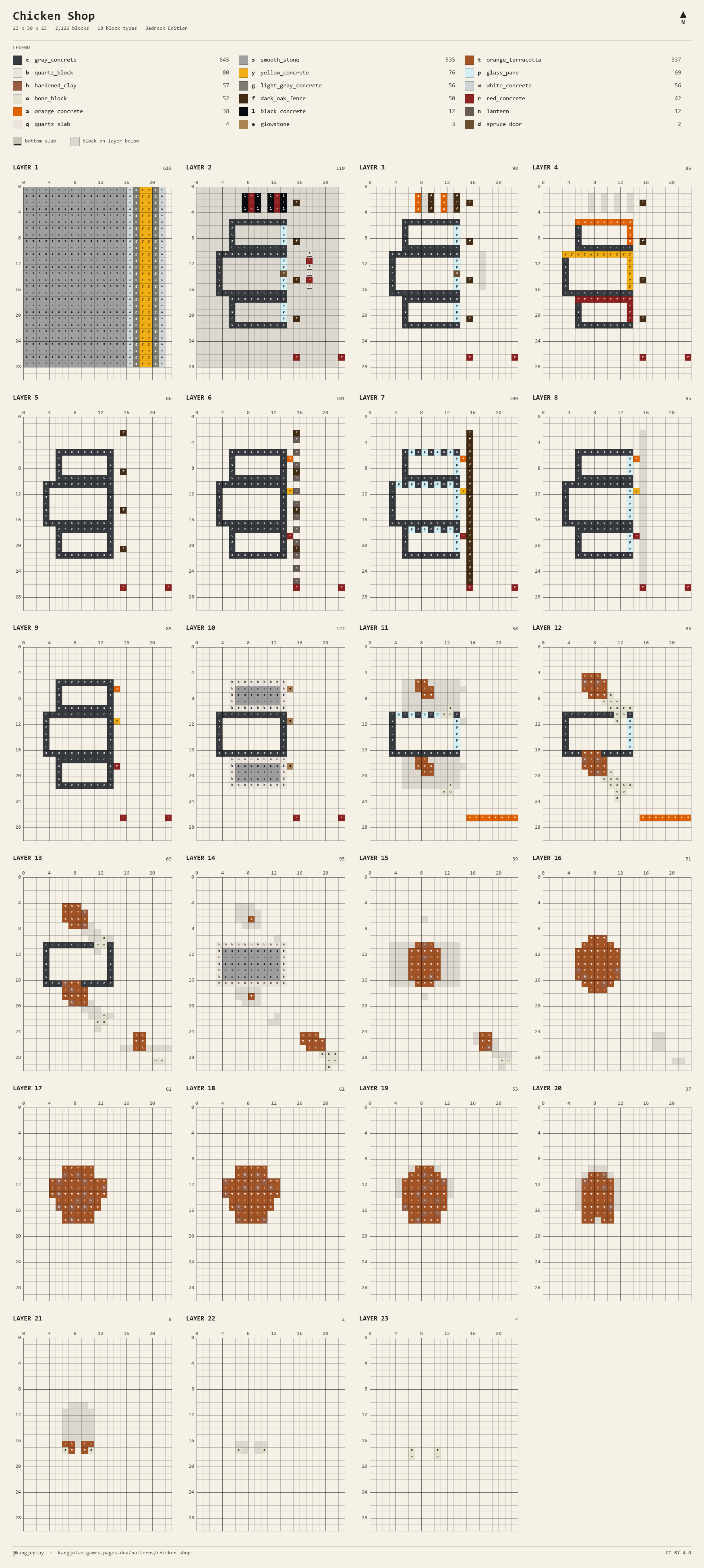
A chicken street of three dark gray shops in a row. The middle shop is wider and taller and carries a huge roast chicken on its roof, while each of the two side shops has a drumstick lying across its roof at an angle. A street with a double yellow line runs past the shopfronts, with string lights along it, an arch across its south end (with another drumstick on top), six delivery bikes beside the shops and two tables out on the street. 23 × 30 blocks, 23 layers, 2,126 blocks, 18 block types.
The right-hand (east) side of the pattern is the front. All three shops have gray concrete walls and are told apart by the colour of the band over their windows and of their projecting sign — orange for the north shop, yellow for the middle, red for the south. The chicken and drumsticks are orange terracotta dotted with brown terracotta for the roasted skin, with bone blocks for the bones. In the short, the chicken shop grows over a day, a month and a year — one shop with a drumstick on its roof (433 blocks), then a shop with a white plate and a roast chicken on its second floor (1,206), then the chicken street of three shops (2,126). This pattern is the last, one-year stage.
Layer by layer — three shops, a street in front, a roast chicken on top
LAYER 1 — yard and street. 448 smooth stone for a 16 × 28 yard, with a street six blocks wide on its east side. From edge to edge the street is one row each of white, light gray, yellow, yellow, light gray and white concrete (56 of each colour), so a double yellow line runs down the middle.
LAYER 2–10 — the side shops. The north and south shops are identical, 9 × 5 (237 blocks each). LAYER 2–3 is a glass pane shop window three wide on the front, LAYER 4 a coloured band round the front and north side, LAYER 7–8 the upper windows (on the north side, every other block on LAYER 7), and LAYER 10 a flat roof of smooth stone edged in quartz.
LAYER 2–14 — the middle shop. 11 × 7, bigger than its neighbours (449 blocks), and two blocks deeper at the back (west). A spruce door sits in the middle of the front on LAYER 2–3 with glass panes two wide either side, a yellow band on LAYER 4, and windows five wide on LAYER 7–8 and again on LAYER 11–12 — one row more than the side shops. The roof is LAYER 14.
LAYER 6–10 — projecting signs. For each shop, one block out from the front wall, stack four concrete blocks in its band colour (LAYER 6–9) and top them with a glowstone. Orange, yellow, red — 15 blocks.
LAYER 2–7 — string lights. In the row between the shopfronts and the street, stand four dark oak fence posts six high and run a line of 24 fences along LAYER 7. Hang 12 lanterns beneath it on LAYER 6, one every other block.
On the roofs — roast chicken and drumsticks. The roast chicken sits on the middle shop's roof (LAYER 14) and rises through LAYER 15–23 — 9 × 9 at its widest on LAYER 17–18, with two legs sticking up at the south end, each finished with four bone blocks (308 blocks). The drumsticks on the side roofs (LAYER 10) are 53 blocks each and lie at an angle across LAYER 11–14; the north one rests its bone end against the middle shop's wall, the south one its meaty end.
Arch, bikes and tables. At the south end of the street, stand two red concrete pillars (LAYER 2–10) either side of it, lay a two-high orange concrete beam eight long across them on LAYER 11–12, and set a drumstick (32 blocks) on top on LAYER 13–15. In the yard beside the north shop, six delivery bikes stand in two rows of three — each is five blocks: rear wheel, body and front wheel (black, red and black concrete) with an orange delivery box over the back and a fence handlebar over the front. Out on the street in front of the middle shop are two tables, each a red concrete block with a quartz slab seat either side.
How much material?
Gray concrete, 645 is the biggest item and all of it is shop wall: 81 batches of powder — 324 sand, 324 gravel and 81 gray dye. All seven concrete colours come to 925 blocks, or 472 sand and 472 gravel, with 10 yellow, 7 light gray, 7 white, 6 red, 5 orange and 2 black dye on top.
Smooth stone, 535 (448 yard, 87 roofs) is cobblestone smelted twice — 1,070 smelts, about 134 coal.
Orange terracotta, 337: dye terracotta 8 at a time with 1 orange dye — 344 terracotta and 43 orange dye. With the 57 brown-spot terracotta that is 401 clay blocks (1,604 clay balls) to smelt. Badlands have both orange terracotta and terracotta lying in the ground, so mining them there is much quicker.
Bone blocks, 52 take 9 bone meal each — 468 bone meal, or 156 bones. Then 80 quartz blocks (320 nether quartz), 69 glass panes (30 glass), 50 dark oak fences (17 crafts make 51), 12 lanterns (96 iron nuggets, 12 torches), 4 quartz slabs, 3 glowstone and one spruce door (two blocks on the pattern, top and bottom). The 4 quartz slabs are 2 quartz blocks at a stonecutter, or 3 at a crafting table (6 per craft).
Tips
Line all three shopfronts up on the same column (column 13 of the pattern). Only the middle shop reaches two blocks further back, so counting from the front keeps the three side by side. The coloured bands are a single row on LAYER 4 and easy to miss while stacking walls.
Grow the roast chicken from its 5 × 7 base on LAYER 15 one layer at a time to the 9 × 9 of LAYER 17–18, then narrow it again. The brown terracotta spots move from layer to layer, so place them as drawn to keep the roasting even.
The drumsticks stick out into the air at an angle, so start each from the meaty end and run the bones outward — that way every block has a face to go against. The arch's east pillar stands just off the street, on a cell where LAYER 1 has no block; put one block there at LAYER 1 height first, or the pillar comes up one short of the beam.