
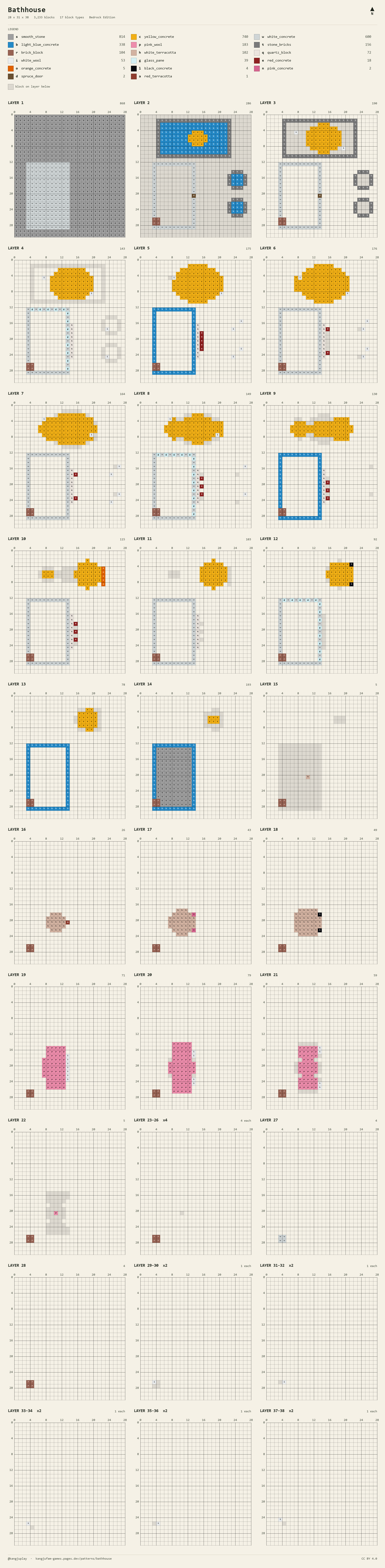
A white three-storey jjimjilbang — a Korean bathhouse and sauna — banded in light blue. A big ♨ sign hangs over the front door, a brick chimney at the south-west corner rises 14 blocks above the roof with steam curling from the top, and on the roof a giant face wearing a pink towel tied sheep-style looks out over the front. In the big outdoor bath north of the building floats a giant rubber duck as tall as the building itself, and two round small baths sit in the front yard. 28 × 31 blocks, 38 layers, 3,233 blocks, 17 block types.
The right-hand (east) side of the pattern is the front. The walls are white concrete, with light blue concrete for the top row of each storey and the roof edge — and for the bath water too, so it is coloured blocks rather than real water. The face is white terracotta, which despite the name is a pinkish beige and makes a good skin tone. In the short, the bathhouse grows over a day, a month and a year — a neighbourhood bathhouse with a ♨ sign and chimney (602 blocks), then a two-storey sauna with an open-air bath on the roof (978), then the three-storey jjimjilbang (3,233). This pattern is the last, one-year stage.
Layer by layer — three storeys, a face on the roof, three baths in the yard
LAYER 1 — floor. 681 smooth stone cover the whole 28 × 31 plot, with the building's 11 × 17 floor in 187 white concrete in the south-west part.
LAYER 2–13 — three storeys of wall. Each storey is four rows round the 11 × 17 outline: two of white, one window row (white and glass panes alternating) and one light blue band. The windows are on LAYER 4, 8 and 12 — 13 panes each, on the north side and the front only — and the bands on LAYER 5, 9 and 13. A spruce door sits in the middle of the front on LAYER 2–3.
LAYER 14 — roof. 50 light blue concrete round the edge, 133 smooth stone inside.
LAYER 4–11 — the ♨ sign. Right above the door, fix a 9 × 8 panel of quartz blocks (72) to the front wall and set the ♨ in 18 red concrete one block proud of it — the round tub at the bottom (LAYER 5–7), three wavy lines of steam above it (LAYER 8–10).
LAYER 2–38 — chimney and steam. At the building's south-west corner, raise a 2 × 2 brick chimney (104 bricks) to LAYER 28; LAYER 27 alone is a band of white concrete. Above it, LAYER 29–38 carry 10 white wool, one per layer, stepping sideways every two layers so the steam wiggles upward.
LAYER 15–22 — the towel face. On the roof, stand a round face of 102 white terracotta (LAYER 15–18) facing the front, with two black eyes (LAYER 18), two pink cheeks (LAYER 17) and a red terracotta mouth (LAYER 16) on its front. LAYER 19–21 are the towel — 183 pink wool, with a rolled bun on each side like sheep's horns and 15 white wool along the front edge — and one more pink wool tops it off on LAYER 22.
In the yard — big outdoor bath and giant rubber duck. North of the building, lay a 19 × 10 rim of stone bricks two high (LAYER 2–3, 108) and fill it with 120 light blue concrete water. The rubber duck rises from the middle through LAYER 2–14 in 740 yellow concrete — its head toward the front with an orange beak of 5 (LAYER 10) and two black eyes (LAYER 12), its tail raised at the other end. Two wisps of white wool steam (12) rise over the water.
In the yard — two small baths. In the front yard, two 5 × 5 stone brick tubs with the corners cut off (41 blocks each), two high, with 3 × 3 light blue water inside and two wisps of steam above each.
How much material? — one duck, 740 concrete
Yellow concrete, 740 is all rubber duck: 93 batches of powder — 372 sand, 372 gravel and 93 yellow dye (dandelions or sunflowers). All seven concrete colours come to 1,707 blocks, more than half the build — 868 sand and 868 gravel, plus 75 white and 43 light blue dye, 3 red and 1 each of orange, black and pink.
Smooth stone, 814 (681 plot, 133 roof) is cobblestone smelted twice — 1,628 smelts, about 204 coal. White concrete, 600 is 409 wall, 187 floor and 4 for the chimney band; light blue concrete, 338 is 200 for bands and roof edge and 138 for bath water.
Pink wool, 183: dye a sheep pink and each shearing gives 1–3 pink wool. White terracotta, 102 is terracotta dyed 8 at a time with 1 white dye — 104 terracotta (104 clay blocks, 416 clay balls) and 13 dye. Bricks, 104 take 4 brick items each, so another 416 clay balls to smelt.
Then 156 stone bricks (156 stone), 72 quartz blocks (288 nether quartz), 53 white wool, 39 glass panes (18 glass) and 18 red concrete. The duck's beak and eyes and the face's cheeks and mouth are only a handful of blocks each.
Tips
Lay the outdoor bath rim first and the duck has its place. The duck widens layer by layer from 16 blocks on LAYER 2 to its broadest body on LAYER 6, then narrows again — on each layer, place the outline first and fill in after.
All the steam, over the chimney and over the baths, steps sideways every two layers, and at each step a block touches the one below only at an edge. Minecraft needs a face to place against, so put a temporary block beside it, place the wool, then break the temporary block.
The pattern groups identical layers. LAYER 23–26, where only the chimney remains, are drawn once as x4, and the steam-only LAYER 29–38 in pairs as x2 — which is how 30 panels cover 38 layers.