
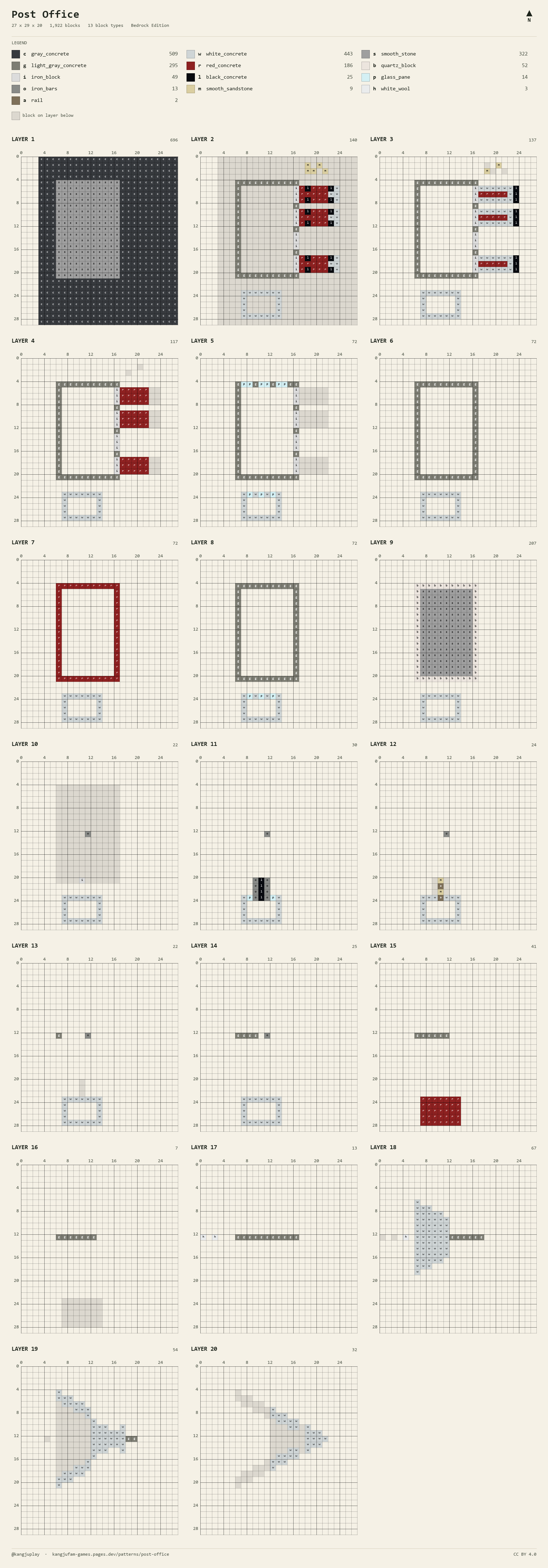
A long, low logistics centre with light gray concrete walls. Four iron-block loading doors line the front, and three red mail trucks have backed up to three of them. On the south side a white sorting tower rises six layers above the centre's roof, linked to it by a parcel bridge, and over the roof a giant paper plane floats on a single iron-bar post, nose raised toward the front. 27 × 29 blocks, 20 layers, 1,922 blocks, 13 block types.
The right-hand (east) side of the pattern is the front. The centre is light gray concrete with one band of red concrete and a flat roof edged in quartz; the truck bodies and the tower roof are the same red. In the short, the post office grows over a day, a month and a year — a giant postbox with a letter sticking out (569 blocks), then a white post office with a red hipped roof and an envelope sign (955), then the logistics centre (1,922). This pattern is the last, one-year stage.
Layer by layer — the logistics centre, a tower beside it, a plane above
LAYER 1 — yard and floor. 509 gray concrete make a 24 × 29 yard, with the centre's 11 × 17 floor in 187 smooth stone on its west side. The trucks stand east of the building, and the sorting tower goes at the bottom (south) of the pattern.
LAYER 2–8 — the centre's walls. Seven courses of light gray concrete round the 11 × 17 outline (52 a layer). On the front, LAYER 2–5 hold four iron block loading doors, each 3 wide × 4 high (48 blocks), with a one-block light gray pier between them. LAYER 5 has three two-pane windows in the north wall, and LAYER 7 is a band of red concrete all the way round (52).
LAYER 9 — flat roof. 52 quartz blocks round the edge, 135 smooth stone inside.
In the yard — three mail trucks and parcels. Each truck is 57 blocks, 7 long × 3 wide × 3 high. The five-block cargo box is red on LAYER 2, white along the sides on LAYER 3 and red on top on LAYER 4; the two-block cab in front is white and two high with a black windscreen, and four black concrete wheels sit underneath. All three back their cargo boxes up to a loading door, leaving the third door from the north empty. Seven smooth sandstone parcels are stacked two high along the north edge of the yard.
LAYER 2–15 — the sorting tower. South of the centre, build a hollow 7 × 5 tower in white concrete up to LAYER 14, with glass pane windows on LAYER 5, 8 and 11 of the north face, looking at the centre. LAYER 15 is a roof of 35 red concrete.
LAYER 10–12 — the parcel bridge. A four-block bridge runs from the south edge of the centre's roof into the tower on LAYER 11: four black concrete deck blocks, eight iron bar railings and one iron block support under the roof end. On the deck (LAYER 12), smooth sandstone parcels and rails alternate, two of each.
LAYER 10–20 — the giant paper plane. A post of five iron bars (LAYER 10–14) in the middle of the roof holds the plane up. The folded body under the wings is 37 light gray concrete, deepest toward the tail (west), where it reaches down to LAYER 13. The wings are 144 white concrete over LAYER 18–20, climbing a layer at a time from tail to nose, and the tail end is 17 wide — the full depth of the building. The nose reaches five blocks out past the front wall, over the trucks. Behind the tail, three white wool blocks dot the air like a vapour trail.
Gathering materials — three blocks in four are concrete
Concrete is 1,458 blocks, about 76% of the build. The biggest item, 509 gray concrete, is all the LAYER 1 yard. Making all five colours as concrete takes 185 batches of 8 powder (4 sand, 4 gravel, 1 dye): 740 sand and 740 gravel, plus 64 gray, 56 white, 37 light gray, 24 red and 4 black dye.
Of the 443 white concrete, 248 go into the sorting tower, 144 into the plane's wings and 51 into the trucks. White dye can be made from bone meal, so the 56 dye need just 19 bones.
Smooth stone, 322 (187 floor, 135 roof) is cobblestone smelted twice — 644 smelts, about 81 coal. Iron blocks, 49 are 441 ingots, and 48 of them are the loading doors; if iron is short, white concrete is close in colour.
Then 52 quartz blocks (208 nether quartz), 14 glass panes (6 glass make 16), 13 iron bars (6 ingots make 16), 9 smooth sandstone, 3 white wool and 2 rails (one craft makes 16).
Tips
Put up the centre's walls first and mark the four loading doors in iron on LAYER 2. Set each truck with the back of its cargo box on the block just outside a door and it lines up by itself. Lay the parcel bridge only once the tower is up to LAYER 11, so both ends meet.
The plane hangs in mid-air, so order matters. Raise the iron bar post to LAYER 14, attach the six body blocks of LAYER 15 to its top, then work down (LAYER 13–14) and up (LAYER 16 onward) from there — every block then has a face to go against, all the way to the wingtips.
The three white wool blocks behind the tail touch nothing. Place a temporary block beside each, attach the wool, then break the temporary block.