
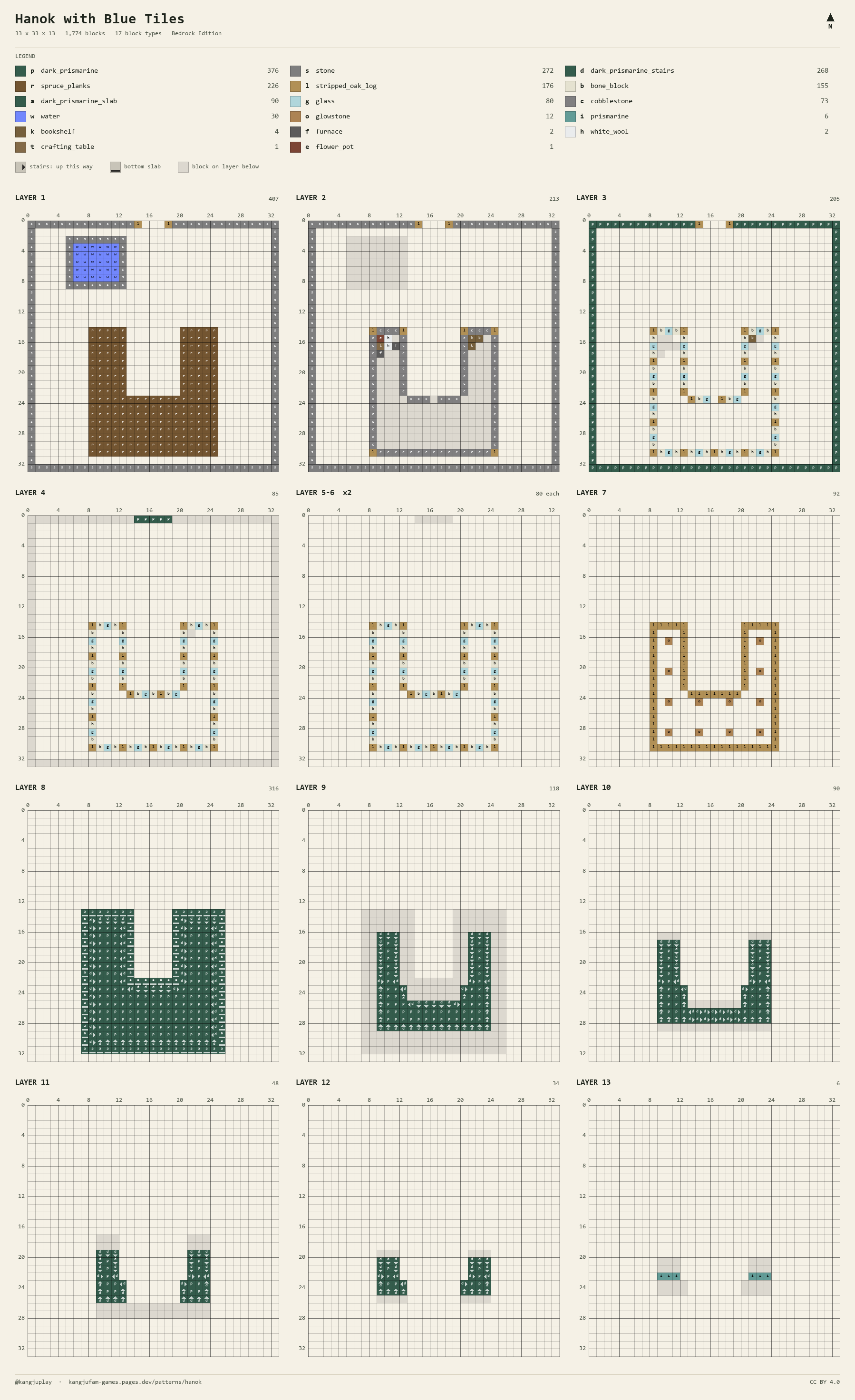
A traditional Korean house (hanok) with three wings joined in a U around a courtyard. A 33 × 33 stone wall surrounds the plot, with a gate in the north wall (the top of the pattern) and a square pond just inside the gate. The house sits in the southern half, its open side facing the courtyard.
The roof tiles are dark prismarine — a deep blue-green that reads as the blue glazed tiles of Korean palaces — with stairs turning the eaves up at the edges. The walls pair white bone blocks with stripped oak log posts for the plaster-and-timber look. 1,774 blocks, 17 block types.
Layer by layer — floor, walls, roof, garden wall
LAYER 1 — the plot. Outline the garden wall in stone and lay the U-shaped floor with 226 spruce planks. The pond goes in on this layer too: 30 water inside a stone rim.
LAYER 2 — plinth and furniture. Run a row of cobblestone along the base of the walls. Place the bookshelves, furnaces, wool bed, crafting table and flower pot before the walls go up — it is much easier than turning around inside a narrow room later.
LAYER 3–6 — walls. Log posts at the corners and at regular intervals, bone block and glass in between. LAYER 5 and 6 are identical, so the pattern groups them as x2. The garden wall gets its dark prismarine cap on LAYER 3, and the gate its five-block roof on LAYER 4.
LAYER 7 — beam and lights. A ring of logs tops the walls, with 12 glowstone set into it. Finish lighting here; the roof closes it off.
LAYER 8–13 — tile roof. LAYER 8 is the eave, one block wider than the walls on every side and the biggest layer at 316 blocks. Each layer steps in by one, with stairs along the edges. LAYER 13 is the ridge: three prismarine at the end of each wing.
Gathering materials — it is all about dark prismarine
The roof is almost half the build: 376 dark prismarine, 268 stairs and 90 slabs. With a stonecutter (one block → one stair or two slabs) you need 689 dark prismarine in total. At a crafting table (6 blocks → 4 stairs, 3 → 6 slabs) it is 823.
Each dark prismarine takes 8 prismarine shards and 1 ink sac (black dye), so 689 blocks means 5,512 shards — in survival, plan on an ocean-monument guardian farm. If that is too much, swap the roof to dark oak or deepslate tile blocks; the shape still reads the same.
Everything else is common. Smelt cobblestone for the 272 stone, craft bone blocks from 9 bone meal each, strip logs with an axe, smelt sand for the 80 glass, and craft glowstone from 4 dust gathered in the Nether.
Tips
Build the garden wall first — it gives you a 33 × 33 reference frame, and the house then sits between columns 8–25 and rows 14–31 of the grid.
The triangle on a stair cell points to its high side. Place the first ring of eave stairs on LAYER 8 and look at it from a distance before going higher; a flipped stair makes the roof look inverted.
The inside corners of the U, where the wings meet the main hall, are where roof stairs change direction and where mistakes happen. Zoom into those cells on the pattern before placing them.