
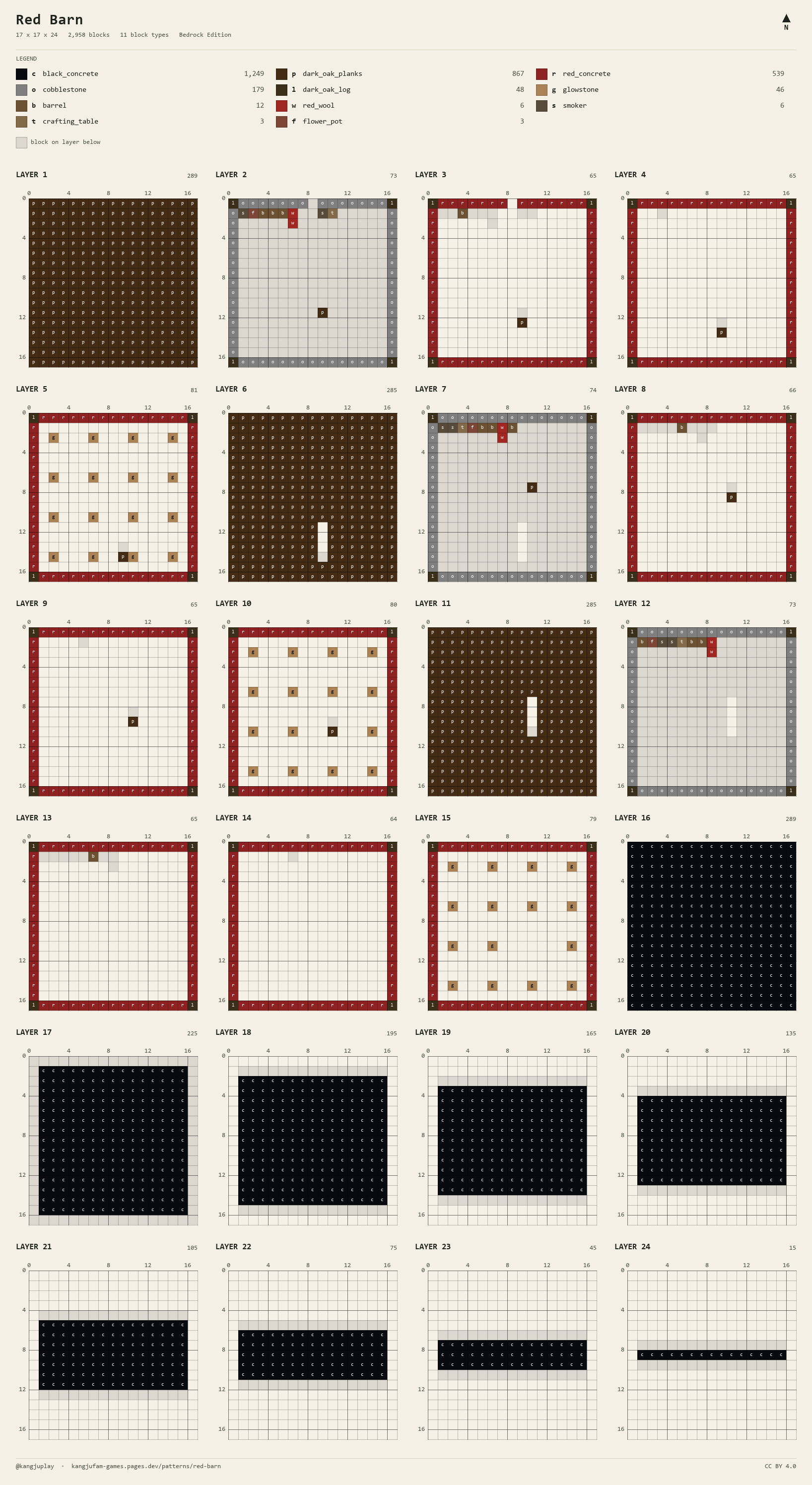
A barn: three storeys of red concrete wall on a 17 × 17 floor, under a gable roof of black concrete that steps in from front and back. 24 layers, 2,958 blocks. Red walls and a black roof read as a barn in any country.
In the short, the barn grows through three sizes — small (195 blocks), medium (852) and large (2,958). This pattern is the largest. The three storeys are identical and the roof shrinks by one block front and back per layer, so it is easier to read than its size suggests. The roof alone, though, is 1,249 blocks, 42% of the build.
Layer by layer — one storey three times, then the roof
LAYER 1 — floor. Fill 17 × 17 with 289 dark oak planks.
LAYER 2–5 — ground floor. LAYER 2 is a 59-cobblestone base with a dark oak log post in each corner; LAYER 3–5 are red concrete walls (59–60 each) with the same four posts. LAYER 5 also has 16 glowstone inside as ceiling lights. One wall layer is 4 logs + about 60 red concrete — that is the unit of this pattern.
LAYER 6 — second floor. Another 17 × 17 of planks, leaving a few cells open for the stairs.
LAYER 7–10 and 12–15 — second and third storeys. Repeat the ground-floor sequence twice; LAYER 11 is the third floor. The upper storeys use 15 glowstone each.
LAYER 16 — ceiling. Cover the full 17 × 17 with 289 black concrete. This layer is both the barn's ceiling and the base of the roof.
LAYER 17–24 — gable roof. LAYER 17 is 15 × 15, one block in on every side. From there the width stays 15 and only the depth shrinks by one on each side per layer — 15 × 13, 15 × 11, 15 × 9 … down to a 15 × 1 ridge on LAYER 24. The roof is solid black concrete all the way through, with no stair blocks, which is what gives it the flat barn-roof faces.
How much material?
Black concrete, 1,249 is the big one. Concrete is placed as powder and set with water; 8 powder = 4 sand + 4 gravel + 1 black dye, so 1,249 powder is 625 sand, 625 gravel and 157 black dye (157 ink sacs). Lay one roof layer of powder at a time and pour water over it.
Red concrete, 539 is 270 sand, 270 gravel and 68 red dye — one poppy, red tulip or beetroot each.
Dark oak planks, 867 is 217 logs; add 48 logs for the posts and you need about 265 dark oak logs. Dark oak must be planted 2 × 2 and gives a lot of wood per tree, so around 30 trees.
179 cobblestone, 46 glowstone (184 glowstone dust), and the furniture — 12 barrels, 6 smokers, 3 crafting tables, 3 flower pots, 6 red wool — are small. Furniture can be swapped for anything of a similar colour without changing the outside.
Tips
Raise the four corner log posts to 15 blocks first; the three storeys of wall then just fill in between them. A post that is off by one block is the first thing you notice from a distance.
Once LAYER 16 is fully covered and LAYER 17's 15 × 15 is right, the rest of the roof is just stepping in one block front and back per layer. The width stays 15 all the way up.
Concrete powder falls, so powder placed on the roof can slide into the floors below. Finish the LAYER 16 ceiling before starting the roof, and set each layer with water before placing the next.