
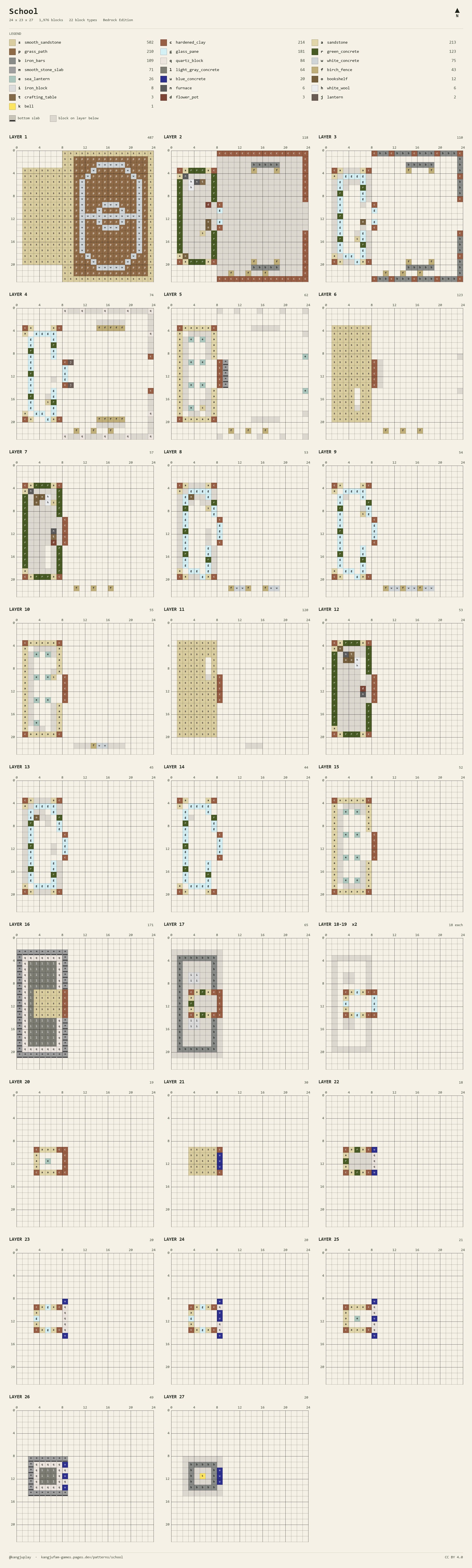
A long three-storey main building with a brick clock tower rising to five storeys in the middle, topped by a round clock and a bell. In front is a playground of dirt path with a white running track, two goals and three flagpoles, closed in by a brick-and-iron-bar wall with a gate. 24 × 23 blocks, 27 layers, 1,976 blocks, 22 block types.
The right-hand (east) side of the pattern is the front, and the playground fills most of that side. The walls are cream sandstone and smooth sandstone, the corners, tower and wall are terracotta, and a green concrete sill runs under the window band on every floor. In the short, the school grows through three sizes — small (453 blocks), medium (837) and large (1,976). This pattern is the largest.
Layer by layer — playground, three storeys, then the clock tower
LAYER 1 — floor and playground. 214 smooth sandstone for the 7 × 17 building floor and the paving in front. The 13 × 21 playground is 210 dirt path with 63 white concrete lines — a track oval one block in from the edge, a halfway line and a centre circle.
LAYER 2–5 — ground floor. Terracotta corners and sandstone walls. LAYER 2 is the green concrete sill row, LAYER 3–4 a window band of glass panes set one block in with green mullions, LAYER 5 a sandstone lintel row with sea lanterns in the ceiling. At the clock tower in the middle of the front, a terracotta panel stands one block proud, with the entrance door and glass panes either side, and a five-slab smooth stone canopy on LAYER 5 with two lanterns hanging beneath.
LAYER 2–5 — around the playground. The wall is a course of terracotta on LAYER 2 and iron bars on LAYER 3, with quartz caps here and there on LAYER 4. The gate is the five-block gap in the middle of the right-hand wall, with a sea lantern on each gatepost (LAYER 5). At each end of the playground's long axis a goal faces the other — birch fence posts and crossbar with an iron bar net behind, 5 wide and 3 high.
Flagpoles. Three birch fence poles stand at the far end of the playground (inside the bottom wall of the pattern), each with a white concrete flag near the top — plain white, no design.
LAYER 6 — second floor. 115 smooth sandstone. LAYER 7–10 — second floor, LAYER 11 — third-floor deck and LAYER 12–15 — third floor repeat the ground floor: sill, two rows of window band, lintel.
LAYER 16–17 — main roof. Light gray concrete with quartz coping and a smooth stone slab lip; LAYER 17 adds 39 iron bars as a railing and two iron block air-conditioning units (8 blocks).
LAYER 17–27 — upper clock tower. The 5 × 5 tower rises two more storeys above the roof (floor on LAYER 21). LAYER 26 is a 7 × 7 tower roof and LAYER 27 a railing of 16 iron bars with the bell in the middle.
LAYER 21–27 — the clock. A 7 × 7 clock sits on the upper part of the tower's terracotta panel: quartz for the white face, 20 blue concrete for the rim and hands, corners left open so it reads as round. The centre is on LAYER 24; the long hand goes up two blocks (12 o'clock) and the short hand one block sideways (3 o'clock).
How much material?
Sandstone is the big one — 502 smooth sandstone and 213 sandstone. Sandstone is 4 sand, and smooth sandstone is sandstone smelted once more, so the total is 715 sandstone = 2,860 sand. Mining the natural sandstone under desert sand saves a lot of sand-collecting.
Terracotta, 214 is 214 clay blocks (856 clay balls) smelted. Dirt path, 210 is quickest made in place: lay grass blocks and use a shovel on them.
Glass panes, 181 take 72 glass (72 sand). Green concrete, 123 is 64 sand, 64 gravel and 16 green dye (smelt cactus), and iron bars, 109 are 42 iron ingots (6 make 16).
Then 84 quartz blocks, 75 white concrete, 71 smooth stone slabs, 64 light gray concrete, 43 birch fences, 26 sea lanterns and 20 blue concrete. 12 bookshelves, 6 furnaces, 6 white wool, 3 crafting tables and 3 flower pots are furniture. The bell cannot be crafted — take one from a village or trade a villager for it.
Tips
Start with the playground. Place the white lines on LAYER 1 — track oval, halfway line, centre circle — before filling in the dirt path, and the oval will not drift. The wall is only LAYER 2–4, so it can go on last.
The terracotta panel at the front of the clock tower stands one block in front of the main wall, from the ground to the top. That step forward is what makes the middle of the long building stand out.
Check the clock from the front when it is done: the long hand at 12, the short hand at 3. If it reads 9 o'clock it is mirrored — move the short hand on LAYER 24 to the other side.