
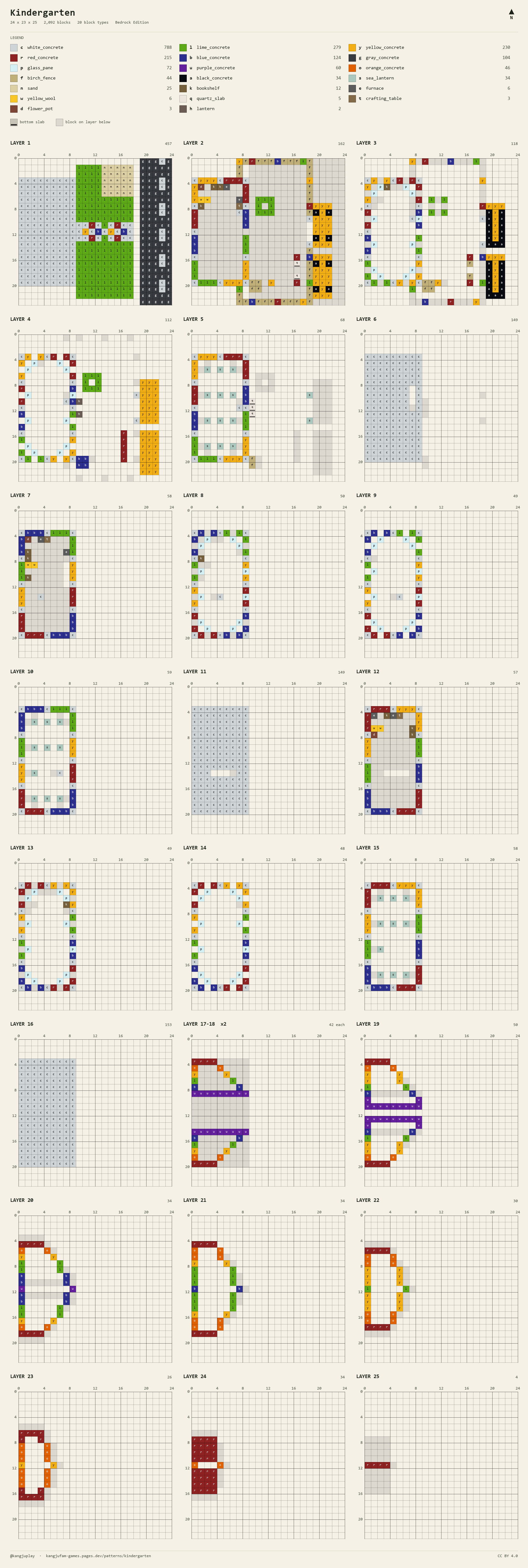
A three-storey kindergarten whose white pillars frame panels of red, yellow, blue and lime. The roof is a rainbow arch — six bands from purple to red — and in front a lime-green playground holds a sandpit, climbing frame, swing and slide. Outside the playground fence, two yellow buses wait on the road. 24 × 23 blocks, 25 layers, 2,092 blocks, 20 block types.
The right-hand (east) side of the pattern is the front. White concrete pillars stand every four blocks with three-block colour panels between them, and the same spot takes a different colour on each floor, so the front reads as a colour grid. About 90% of the build (1,880 blocks) is concrete. In the short, the kindergarten grows through three sizes — small (235 blocks), medium (889) and large (2,092). This pattern is the largest.
Layer by layer — playground and road, three floors, a rainbow roof
LAYER 1 — floors. 153 white concrete for the 9 × 17 building. The 9 × 21 playground in front is 139 lime concrete, with a 5 × 5 sandpit of 25 sand in its top-right (north-east) corner. A three-wide white path runs from the door to the gate, dotted with 10 red, yellow, blue and lime blocks, and the five-wide road outside the fence is 104 gray concrete with a dashed line of 11 white concrete.
LAYER 2–5 — ground floor. White concrete at the corners and every four blocks, with three-block colour panels between. Each panel has a window in the middle, 1 wide and 2 high (LAYER 3–4), with the glass pane mostly set one block in for shadow. The front door takes the pillar spot in the middle of the front wall (LAYER 2–3), with a canopy of three quartz slabs above it on LAYER 5 and a lantern hanging either side beneath. LAYER 5 is a solid row of colour with no windows, and 12 sea lanterns go in the ceiling.
Playground — fence, climbing frame, swing, slide. The fence is 32 birch fences broken by 12 two-high colour concrete posts. The gate is the three-block gap in the middle of the front fence, with a sea lantern on each three-high white concrete gatepost. The climbing frame is just the edges of a 3 × 3 × 3 cube in 20 lime concrete; the swing is two red concrete posts and a crossbar (9 blocks) with two fence chains and two quartz slab seats; the slide is a 2 × 2 blue concrete deck on fence legs at LAYER 4, with two yellow concrete blocks stepping down from it.
On the road — two yellow buses. Each bus is 63 blocks: fill a 3 wide × 7 long × 3 high box with yellow concrete, then swap in black concrete for four wheels on LAYER 2 and ten side windows plus a three-block windscreen on LAYER 3. Both windscreens face the bottom (south) of the pattern, and one bus stops right in front of the gate.
LAYER 6 and 11 — second and third floors. 149 white concrete each, leaving four gaps for the stairs. LAYER 7–10 and LAYER 12–15 repeat the ground floor — white pillars, colour panels, middle windows (LAYER 8–9 and 13–14), a solid colour row and 10 ceiling sea lanterns — but the colours move. Reading the front from the top (north) of the pattern: red, blue, lime, yellow on the ground floor; lime, yellow, red, blue on the second; yellow, lime, blue, red on the third.
LAYER 16 — roof deck. 153 white concrete covering the whole 9 × 17.
LAYER 17–25 — the rainbow roof. 296 blocks. From the front it is six nested arches — purple innermost, then blue, lime, yellow, orange and red — and each outer band sits one block higher and one block further back. The purple arch at the front reaches LAYER 20; the red one at the back, four blocks deep, reaches LAYER 25. A five-wide arched opening runs right through the middle from front to back, and the back (west) face shows the same rainbow.
How much material?
Concrete, 1,880, is nearly everything. Powder comes 8 at a time from 4 sand, 4 gravel and 1 dye, and sets when it touches water. All nine colours together are 238 batches — 952 sand and 952 gravel plus 238 dye.
White concrete, 788 is 99 batches (white dye from bone meal or lily of the valley), and 604 of it is the four floors (LAYER 1, 6, 11, 16). Lime, 279 is 35 batches — lime dye is green dye (smelted cactus) mixed with white dye, or a smelted sea pickle. Yellow, 230 is 29 batches, red, 215 27, blue, 124 16, gray, 104 13, purple, 60 8, orange, 46 6 and black, 34 5. Purple dye is red plus blue, orange is red plus yellow, gray is black plus white.
The rainbow roof, 296, is 96 red, 60 purple, 46 orange, 38 yellow, 34 lime and 22 blue. The two buses, 126, are 92 yellow and 34 black — every black concrete block in the build is on a bus.
Then 72 glass panes (30 glass) and 25 sand for the sandpit — about 1,007 sand in all, counting the concrete — plus 44 birch fences, 34 sea lanterns (glowstone works instead), 5 quartz slabs (3 quartz blocks on either a stonecutter or a crafting table) and 2 lanterns. 12 bookshelves, 6 furnaces, 6 yellow wool, 3 crafting tables and 3 flower pots are the same furniture on each floor.
Tips
On each floor, put up the white pillars (corners and every four blocks) first and then fill the panels, and nothing drifts. The panel colours move on every floor, so check that floor's grid before you fill them.
The four gaps in each floor deck are the stairwell. Under the gaps, place four white concrete blocks, each one step higher than the last, as stepping stones — the floor below shows exactly where.
The roof layers are hollow shells with few blocks each, which makes them easy to misplace. On every roof layer, check the left-most column of the pattern (the back face): from each end inwards it should run red, orange, yellow, lime, blue, purple — the upper layers only reach the first few. When it is done, step out front and check that the six arches look even.