
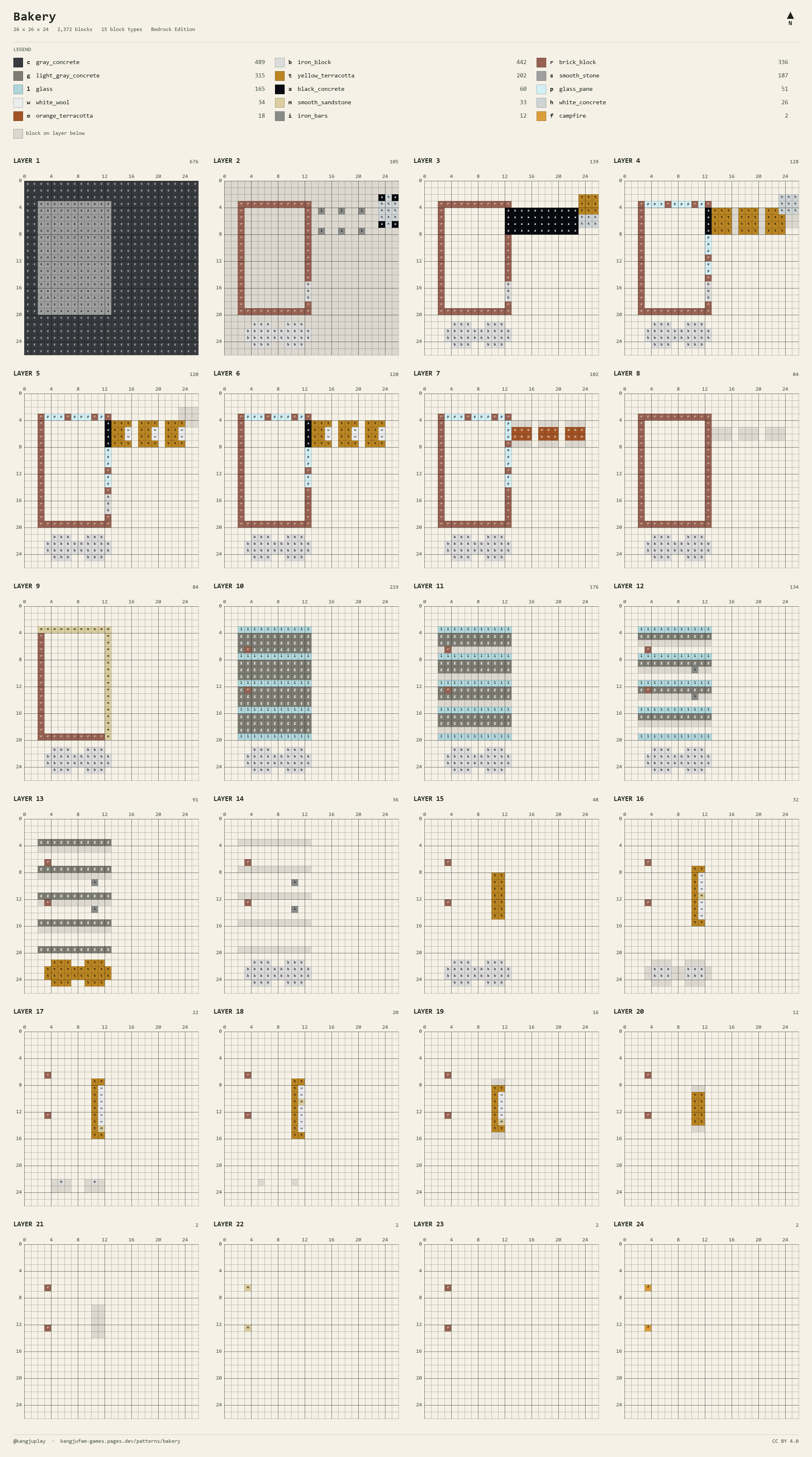
A brick bread factory under a sawtooth roof. On the roof stands a sign shaped like a slice of bread — golden crust, white crumb — and from an opening in the front wall a conveyor carries three giant loaves out to a delivery truck. Two iron block flour silos stand side by side south of the factory, and two brick chimneys rise from the back of the roof. 26 × 26 blocks, 24 layers, 2,372 blocks, 15 block types.
The right-hand (east) side of the pattern is the front. The factory is the 11 × 17 in the upper left of the pattern, and the whole 26 × 26 around it is a gray concrete yard. The walls are bricks with a smooth sandstone band along the top, the roof is light gray concrete and glass, and the loaves are yellow terracotta crust with an orange terracotta top and white wool crumb. In the short, the bakery changes as it grows — a neighbourhood bakery (412 blocks), then a café that is one big cupcake (1,013), then this bread factory (2,372), the last stage.
Layer by layer — the factory, its roof, and five things around it
LAYER 1 — floor and yard. Fill the whole 26 × 26: 187 smooth stone where the factory stands (columns 2–12, rows 3–19) and 489 gray concrete for the rest.
LAYER 2–9 — the brick factory. Brick walls eight high around the 11 × 17. The north side and the front (east) get glass pane windows four rows high on LAYER 4–7 — on the north side, three-wide windows between brick piers every four blocks. At the south end of the front is a 3 × 4 iron block loading door; at the north end, a 4 × 4 black concrete opening where the conveyor comes out. LAYER 9 is a smooth sandstone band along the north side and the front; the west and south walls are plain brick.
LAYER 10–13 — sawtooth roof. One tooth every four rows, north to south. The high edge of each tooth is three glass (LAYER 10–12) under one light gray concrete, and the three rows south of it step down one block at a time, to LAYER 12, 11 and 10. All five glass faces (165 blocks) look north; the light gray concrete comes to 315.
LAYER 10–24 — two chimneys. Two brick stacks rise through the west (left) side of the roof to LAYER 23, with a smooth sandstone band on LAYER 22 and a campfire on top at LAYER 24 to give off smoke. Those campfires are the highest blocks in the pattern.
LAYER 12–20 — the bread sign. Two iron bar posts (LAYER 12–14) stand on the roof and carry a slice of bread 9 wide, 6 high and 2 thick. The back is solid yellow terracotta; the front (east) has a yellow crust edge filled with 22 white wool, with 4 smooth sandstone dotted in like air holes.
LAYER 2–7 — the bread conveyor. A black concrete belt (4 wide, 10 long, LAYER 3) runs east from the front opening on six iron bar legs. On it ride three loaves, each 3 long, 4 wide and 4 high: yellow terracotta crust, the two middle rows of the top in orange terracotta, and a 2 × 2 white wool crumb on the end facing the truck (east).
LAYER 2–4 — the bread truck. A white 3 × 5 truck waits at the end of the belt (top right of the pattern). The north three rows are a three-high box with a band of 9 yellow terracotta round the middle, the south two rows a two-high cab, and black concrete wheels go at the four corners.
LAYER 2–17 — two flour silos. South of the factory (the bottom of the pattern), two round iron block towers, 5 × 4 across, stand touching each other. LAYER 2–15 is the body with a yellow terracotta band on LAYER 13, LAYER 16 a narrower lid and LAYER 17 the tip — 231 blocks each.
Gathering materials — iron blocks and gray concrete
Iron blocks, 442 (3,978 ingots) are the hard part: 430 of them are the silos and 12 the loading door. The 168 blocks inside the silos (156 iron blocks, 12 yellow terracotta) are closed in on every side and never seen, so fill them with anything — that saves 1,404 ingots. White concrete or quartz blocks also work for the whole silo; the shape stays the same.
Gray concrete, 489 is 62 batches of 8 powder (4 sand, 4 gravel, 1 gray dye) — 248 sand, 248 gravel and 62 gray dye. The roof's light gray concrete, 315 is 40 batches (160 sand, 160 gravel, 40 light gray dye), the 60 black for the belt and wheels 8 batches, and the truck's 26 white 4 batches.
Bricks, 336: each brick block is 4 bricks, so 1,344 bricks — smelt 1,344 clay balls (336 clay blocks), about 168 coal. Yellow terracotta, 202 and orange terracotta, 18 are 8 terracotta + 1 dye at a time — 26 yellow and 3 orange batches, so 232 terracotta (smelted from 232 clay blocks), 26 yellow dye and 3 orange dye. Badlands biomes have both colours lying in the ground.
Then 187 smooth stone (cobblestone smelted twice, 374 smelts), 165 glass plus 51 glass panes (24 glass → 64 panes) for 189 sand, 34 white wool, 33 smooth sandstone (33 sandstone = 132 sand), 12 iron bars (6 ingots) and 2 campfires (3 sticks, 1 coal and 3 logs each).
Tips
Think of the sawtooth roof as a north–south cross-section, not as layers. Four rows make one tooth: the first is three glass under one concrete, and the next three are concrete columns three, two and one high. Starting over the north wall (row 3), run those four rows across all 11 columns, repeat four times, and finish with just the first row once more on row 19.
Put up the bread sign after the roof is finished, posts first. The white crumb has to face east (the front), so fill the back row (column 10) solid with yellow terracotta first, then lay the front row (column 11): crust edge, then crumb.
The two silos meet at columns 7 and 8. One body layer is 16 blocks per silo, in rows of 3, 5, 5 and 3 — lay LAYER 2 and check that both circles are round before stacking up.